


The list of services is being updated.
For all necessary information, you can contact us by phone: 8 (8652) 20-55-66


The list of services is being updated.
For all necessary information, you can contact us by phone: 8 (8652) 20-55-66
The list of services is being updated.
For all necessary information, you can contact us by phone: 8 (8652) 20-55-66
This article was prepared for you by Marina Sergeevna Krol, a neurologist and rehabilitation specialist, chief physician of the Neuro Clinic Medical Center. Updated: July 2026.
"Tremor in the hand. Morning stiffness. A shuffling gait. When a patient first hears the diagnosis of Parkinson's disease, their world collapses. But in 20 years of practice, I have seen hundreds of people who, after diagnosis, lived active, fulfilling lives for another 10, 15, or even 20 years. The secret lies in early diagnosis, properly selected therapy, and regular rehabilitation.
At the Neuro Clinic, we do not just prescribe pills. We build a strategy that allows the patient to control the disease, not submit to it. This article will help you understand where to start on this journey."
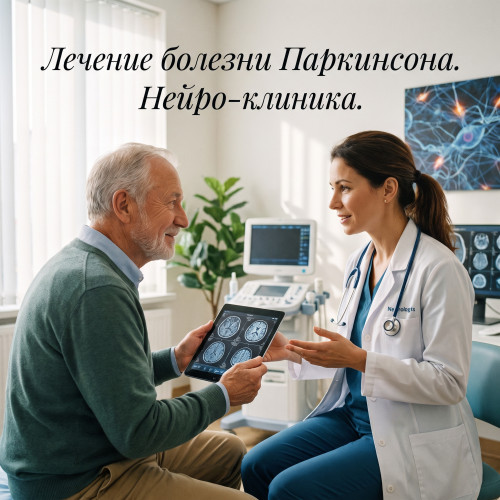
Parkinson's disease is a chronic neurodegenerative disorder in which neurons in a specific area of the brain (the substantia nigra) die off. These neurons produce dopamine, a substance that "conducts" movements. When dopamine levels drop, movements lose their smoothness, and tremor and stiffness appear.
Imagine a car whose power steering is failing. The car runs, the engine works, but every movement of the steering wheel requires enormous effort. Similarly, in Parkinson's: the command to "raise the arm" leaves the brain, but the muscles execute it slowly, jerkily, with trembling.
Parkinson's disease is not dementia, although cognitive impairment may develop in later stages. The motor system is primarily affected. And it is precisely this area that we can actively influence through treatment and rehabilitation.
Symptoms develop gradually, and often the first warnings are noticed not by patients themselves, but by their loved ones.
🩺 Important: Parkinson's disease never begins on both sides simultaneously. Asymmetry is a key diagnostic feature. Tremor or stiffness on one side that gradually spreads is a reason to visit a neurologist.
Parkinson's disease is incurable but well controllable. Properly selected therapy allows you to maintain a normal lifestyle for years.
Medication therapy:
The regimen is selected individually and adjusted as the disease progresses. Self-medication is unacceptable: an incorrect dose can cause severe side effects.
Non-drug methods:
Rehabilitation for Parkinson's disease is not a one-time event but a way of life. The more regular the sessions, the longer mobility is preserved.
Your route at the Neuro Clinic:
Marina Grigorievna Grishchenko, neurologist and reflexologist of the highest qualification category at the Neuro Clinic Medical Center:
"In Parkinson's disease, there is a golden rule: 'Use it or lose it.' The brain is plastic, and regular activity — physical, speech, cognitive — helps maintain neural networks even with dopamine deficiency. Patients who exercise daily walk independently for 3–5 years longer than those who rely only on pills.
At the Neuro Clinic, we combine drug therapy with motor rehabilitation and apparatus methods. And the results are visible: stiffness decreases, gait improves, and confidence in movements returns. Parkinson's disease is not the end. It is the beginning of a different lifestyle, where it is important to take a step forward every day."
If you have noticed tremor, stiffness, or slowness of movement in yourself or a loved one — do not delay a visit to a neurologist. At our multidisciplinary rehabilitation center, you will receive a full cycle: from examination and therapy selection to motor rehabilitation, speech therapy sessions, and apparatus treatment methods.
We have our own treatment room and day hospital — the patient comes on an individual schedule and returns home the same day. You can make an appointment by phone, through the website, or by leaving a request.
"Dear readers! Parkinson's disease requires courage and discipline. But we know how to help. We do not just write prescriptions — we become partners on a long journey. Come, and together we will build a strategy that will allow you to live actively despite the diagnosis." — Marina Sergeevna Krol, neurologist and rehabilitation specialist, chief physician of the Neuro Clinic Medical Center.
CONTRAINDICATIONS EXIST. SPECIALIST CONSULTATION REQUIRED.


