The list of services is being updated.
For all necessary information, you can contact us by phone: 8 (8652) 20-55-66


The list of services is being updated.
For all necessary information, you can contact us by phone: 8 (8652) 20-55-66
The list of services is being updated.
For all necessary information, you can contact us by phone: 8 (8652) 20-55-66
Is your child ready to sit through a lesson?
The start of the school year is a serious test for a first-grader's body. The school desk requires static endurance of the back and abdominal muscles. If the muscles are weak, the child physically cannot concentrate on learning — all attention will go to finding a comfortable position.
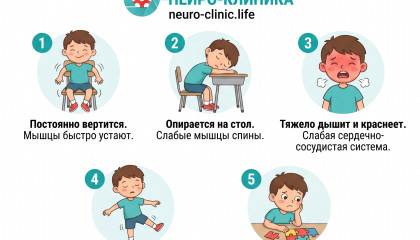
Here is a simple test with 5 signs. If you recognize your child in them, it is a reason to start gentle preparation.
The child cannot sit still for more than 5–7 minutes: squirming, sliding down, twisting legs.
What does this mean? Weak muscle corset — muscles quickly tire from static positions. The body tries to change posture to relieve tension.
Puts head on hand, lies chest down on the desk, elbows are the main point of support.
What does this mean? Weak back muscles cannot hold the spine upright. The child looks for additional support to unload the back. The result — poor posture, compressed chest, and rapid fatigue.
After minor activity, cannot recover breathing for a long time, face turns red.
What does this mean? Weak cardiovascular system. The body struggles even with minimal exertion. In a stuffy classroom after recess, this will cause even more stress.
Ask them to stand on one leg with eyes closed. If they fall after 2–3 seconds and wave their arms.
What does this mean? Weak stabilizer muscles and poor vestibular function. These same muscles are responsible for keeping the body in a sitting position. Without them, the child spends energy not on learning, but on not falling sideways.
Has energy for active games, but reading or doing puzzles quickly becomes boring, starts being capricious.
What does this mean? The nervous system is overexcited. The child needs constant movement stimulation, and calm activities require willpower that is not yet available.
Regular 10–15 minute daily exercises will help strengthen the necessary muscles and make adaptation to school easy and painless.
At Neuro-Clinic, our specialists in physical therapy and neuropsychology will help choose an individual program for your child.

 Children
 Adults

 Children
Adults
Children
Adults
 Children
Adults
Children
Adults