How to distinguish useful fatigue from a dangerous signal.
"I couldn't get out of bed in the morning," "My back ached for three days, I thought I'd broken something" — a physical therapy instructor hears phrases like these regularly. When a person starts therapeutic exercise, especially after a long break, their body faces stress. Pain is frightening, and the first instinct is to give up everything. But progress is built on microscopic tissue damage.
The main task is to learn to distinguish productive growth pain from destructive pain of damage.
1. "Good" pain (DOMS — delayed onset muscle soreness)
This is the soreness that appears not immediately, but 24–72 hours after unusual exertion.
- Character: pulling, aching, diffuse. Felt throughout the entire muscle (for example, the whole front of the thigh hurts).
- When it occurs: with a delay. Immediately after exercise, muscles may simply feel warm or slightly tense.
- Reaction to movement: with a light warm-up or morning walk, the discomfort decreases. The muscles need to be "walked out."
- What to do? This is a sign that the load hit the target. Microscopic fiber tears trigger the supercompensation process — the muscle becomes stronger. Light recovery activities (walks, swimming), quality sleep, and protein in the diet are recommended.
Complete rest here will only slow down recovery.
2. "Bad" pain (traumatic or joint pain)
This is an SOS signal. Ignoring such pain turns rehabilitation into a chronic problem.
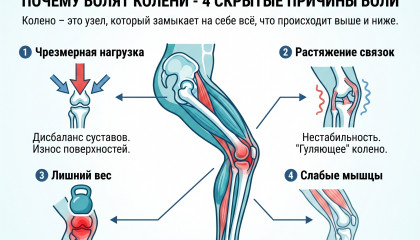
- Character: sharp, acute, shooting, or throbbing. Often accompanied by a sensation of clicking, crunching, or instability.
- Localization: pinpoint. The person clearly points to the place where it hurts. Most often — the area of a joint, ligament, or tendon.
- When it occurs: suddenly, right during the exercise, or remains acute for a long time afterward.
- Reaction to movement: any repetition intensifies the pain. Trying to "endure and finish" leads to worsening of the damage.
- What to do? Immediately stop the load. The principle "no pain — no gain" does not work here.
If the pain does not go away at rest within 24 hours or intensifies, this is a reason to visit an orthopedist or neurologist.
Fatigue is also different
It is important to assess not only pain sensations but also general condition.
- Productive fatigue: local, muscular. After exercise you want to eat, in the evening — deep, calm sleep. In the morning — a feeling of rest.
- Dangerous exhaustion: general heaviness throughout the body, irritability, apathy, poor sleep, rapid pulse even in the morning. These are signs of nervous system overload and insufficient recovery.
The practical "Traffic Light" rule for independent exercise
- Green (keep working): pain is pulling, appeared a day later, covers the whole muscle, goes away with movement. Mood is good, sleep is excellent. Follow the plan as scheduled.
- Yellow (adjust): poor sleep, general fatigue, heavy muscles. Pain is tolerable but unpleasant. Reduce intensity: fewer sets, lighter weight, more attention to technique.
- Red (stop): sharp pinpoint pain, shooting pains, swelling, increased temperature in the joint area. Pain interferes with sleep. Cancel the plan. Rest, cold (if there is swelling), and consultation with a specialist.
You should not fear muscle fatigue — it makes you stronger. You should fear sharp pains and the systematic ignoring of the need for rest.