The list of services is being updated.
For all necessary information, you can contact us by phone: 8 (8652) 20-55-66


The list of services is being updated.
For all necessary information, you can contact us by phone: 8 (8652) 20-55-66
The list of services is being updated.
For all necessary information, you can contact us by phone: 8 (8652) 20-55-66
ADHD (Attention Deficit Hyperactivity Disorder), also known as a hyperkinetic disorder, often describes an energetic and restless child, a "very lively kid." The moment a parent looks away, the child is gone. Soon enough, the runaway can be located by the noise coming from the next room, as though a whole group of preschoolers is playing in the sandbox. Nearby is the family, exhausted from unsuccessful attempts to calm, soothe, or explain the child's behavior to others.
The term ADHD (Attention Deficit Hyperactivity Disorder) originates from North America. In DSM-5 (Diagnostic and Statistical Manual of Mental Disorders, Fifth Edition), ADHD (Attention Deficit Hyperactivity Disorder) is recognized as a condition. In the European classification, the term hyperkinetic disorder is used. According to ICD-10 (International Classification of Diseases, 10th Revision), it is categorized under Emotional Disorders and Behavioral Disorders. However, in ICD-11 (International Classification of Diseases, 11th Revision), the diagnosis is classified under Neurodevelopmental Disorders, justified by research on the disease's etiopathogenesis.
ADHD is a polyetiological mental disorder that begins in childhood and clinically manifests through a triad of cardinal symptoms:
This is the primary symptom of hyperkinetic disorder. Attention varies in meaning depending on people and situations, encompassing a wide range of aspects such as focusing, maintaining attention, and shifting focus. Distractibility (or attention deficit) is characterized by rapid switching of attention to new stimuli triggered by random associations or external irritants. Without intervention, learning problems are inevitable.
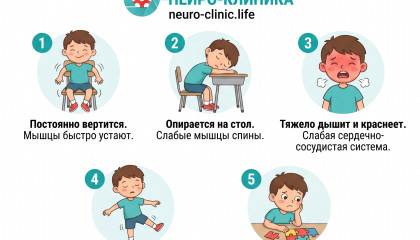
The child is restless, cannot sit still; jumps up without permission; runs aimlessly, fidgets, or climbs in inappropriate situations; cannot play quiet games or rest.
The child acts without waiting for instructions, performing tasks carelessly and hastily. They often fail to assess the task's demands adequately. Consequently, they appear negligent, inattentive, careless, and reckless. Such children frequently fail to recognize potentially negative or harmful consequences associated with specific actions or situations. They often expose themselves to unreasonable risks to demonstrate courage, whims, or defiance, particularly in front of peers.
Diagnostic criteria for ADHD include:
Hyperactivity can also occur outside this diagnosis. It may be a symptom or complication of other psychoneurological conditions.
Therefore: All patients with ADHD exhibit hyperactivity, but not all cases of hyperactivity indicate ADHD.
Three forms of ADHD are distinguished based on the presence and predominance of symptoms:
In the European classification, the term hyperkinetic disorder typically refers to the combined form of ADHD.
The etiology of ADHD is described as follows:
Genetic factors: ADHD is one of the most heritable mental disorders, with heritability estimated at 76%. The disorder manifests clinically more often in boys. Families with ADHD patients are also more likely to have cases of tics or Tourette's syndrome.
Biochemical factors: Certain genes associated with neurotransmitter regulation are implicated in the disorder. However, similar symptoms may result from different imbalances in monoamine systems, including dopamine, serotonin, and norepinephrine pathways.
Neuropsychological factors: These arise from the aforementioned causes and include dysfunction in the associative cortex, basal ganglia, thalamus, cerebellum, prefrontal cortex, and reticular formation. This results in impaired motor control, attention, and working memory. The inability to process information adequately causes visual, auditory, and emotional stimuli to overwhelm the child, leading to restlessness, irritation, and aggression.
E.A. Osipova and N.V. Pankratova identified four types of higher mental function deviations. Their research on ADHD in children aged 5 to 9 demonstrated that the syndrome manifests differently depending on which brain structures are affected. This variability influences both the presentation and prognosis for symptom improvement.
Can ADHD be left untreated?
Early school age is when children develop social skills and lay the foundation for future education. For an impulsive, hyperactive child, these tasks are incredibly challenging. Teachers may dislike the child, and peers may avoid playing with them, as even simple game rules are too much for them to handle. This leads to secondary complications:
Thus, expecting pathological traits to resolve on their own may result in a socially maladjusted, isolated child who is barely promoted through school and frequently disrupts classes with aggressive behavior.
ADHD is linked to dysfunction in intricate brain structures and monoaminergic systems.
Psychopharmacology offers limited solutions. Abroad, first-line medications include psychostimulants like methylphenidate, which have mechanisms and addictive potential similar to narcotic stimulants.
In our country, atomoxetine is used. This drug blocks norepinephrine reuptake and is effective in 90% of attention deficit cases, although it is less effective against hyperactivity. This can result in a medicated but still problematic condition with the same aforementioned consequences.
Our doctors employ a unique method called Bioacoustic Correction, which activates the CNS's self-regulation mechanisms, aiding normal child development and improving cognitive functions like attention, memory, and speech. Additionally, this method supports metabolic processes in the nervous system and promotes the maturation of new brain cells. For ADHD combined with destructive behavior, anxiety disorders, or neuroses, treatment may include micropolarization and adaptive neurofeedback training to enhance synaptic transmission in various brain areas. Sleep and behavioral disorders associated with ADHD often require additional sessions with a neuropsychologist.


 Children
 Adults

 Children
Adults
Children
Adults